
India’s rapid digital transformation has brought undeniable economic and social benefits, but it has also created an escalating environmental challenge—electronic waste, or e-waste. A recent report by the Central Pollution Control Board (CPCB) highlights a troubling reality: while e-waste generation is rising steadily, systems to manage it remain inadequate and poorly implemented.
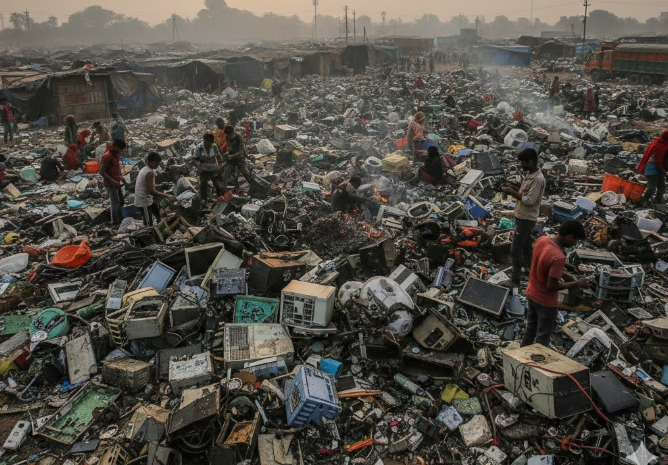
India is now among the world’s largest generators of e-waste, driven by rising consumption of smartphones, laptops, household appliances, and other electronic devices. Shorter product lifecycles and frequent upgrades further accelerate waste generation. However, the CPCB report reveals that the country’s ability to track, collect, and recycle this waste is far from sufficient.
A major concern is the lack of proper data and inventory systems. Only a handful of states and Union Territories have completed comprehensive e-waste inventories covering all categories of electrical and electronic equipment, as mandated under current rules. Without accurate data, planning effective waste management strategies becomes nearly impossible.
The CPCB findings show that compliance with e-waste management rules is uneven across the country. While a few states report adherence, many others continue to struggle with implementation. Non-compliant units and weak enforcement mechanisms remain widespread.
Another critical issue is the poor monitoring of e-waste flows, particularly across state boundaries. The absence of a robust tracking system allows large quantities of waste to move unaccounted, often ending up in informal recycling hubs.
Even more concerning is the underreporting of informal sector activity. While 27 states and UTs claimed no informal e-waste activity during inspections, evidence from regions like Delhi and Chhattisgarh suggests otherwise. This disconnect points to gaps in inspection systems and a lack of on-ground verification.
One of the defining features of India’s e-waste ecosystem is the dominance of the informal sector. Thousands of small-scale scrap dealers and waste pickers handle a significant portion of discarded electronics. While this sector provides livelihoods to many, it often uses unsafe and unscientific methods such as open burning or acid leaching to extract valuable metals.
These practices pose severe environmental and health risks, releasing toxic substances like lead, mercury, and dioxins into the air, soil, and water. At the same time, valuable materials are lost due to inefficient recovery techniques, undermining the concept of a circular economy.
India’s formal e-waste recycling infrastructure is still developing and remains insufficient for the scale of waste generated. Several regions lack adequate recycling facilities, forcing reliance on distant units or informal channels. Recent observations by environmental authorities have also pointed out that many states do not have enough authorised recyclers to handle their waste load effectively.
Policy frameworks, though well-intentioned, also have limitations. For instance, current regulations focus on recovering a limited set of materials such as gold, copper, iron, and aluminium, while ignoring critical minerals like lithium and rare earth elements. This results in the loss of valuable resources essential for emerging technologies like renewable energy and electric vehicles.
Addressing India’s e-waste crisis requires a multi-pronged approach. First, strengthening data systems and ensuring accurate inventory of e-waste is crucial. Without reliable data, policy interventions cannot be effectively targeted.
Second, enforcement mechanisms must be improved. Regular inspections, stricter penalties for non-compliance, and better inter-state coordination are necessary to plug regulatory gaps.
Third, integrating the informal sector into the formal system is essential. Providing training, safety equipment, and formal recognition can help transform this sector into a more sustainable and efficient component of the recycling ecosystem.
Fourth, expanding recycling infrastructure and investing in advanced technologies will enhance recovery rates and reduce environmental harm. At the same time, policy frameworks must evolve to include a broader range of materials and promote circular economy practices.

A CSR Initiative of

Designed and Executed by

Implemented by


 Technology is a useful servant, but a dangerous master, it was rightly said. Electronic devices have grown into an inevitable part of our daily lives.




Leave A Comment